
Trust Center
Security architecture of the Persate platform for security, compliance, and procurement reviewers — data flow, hosting regions, and encryption in transit and at rest.
This page is intended for security, compliance, and procurement teams evaluating Persate. Account-level protections available to every user (passwords, two-step verification, sessions, trusted browsers, login history) are described in Security and privacy.
Security architecture
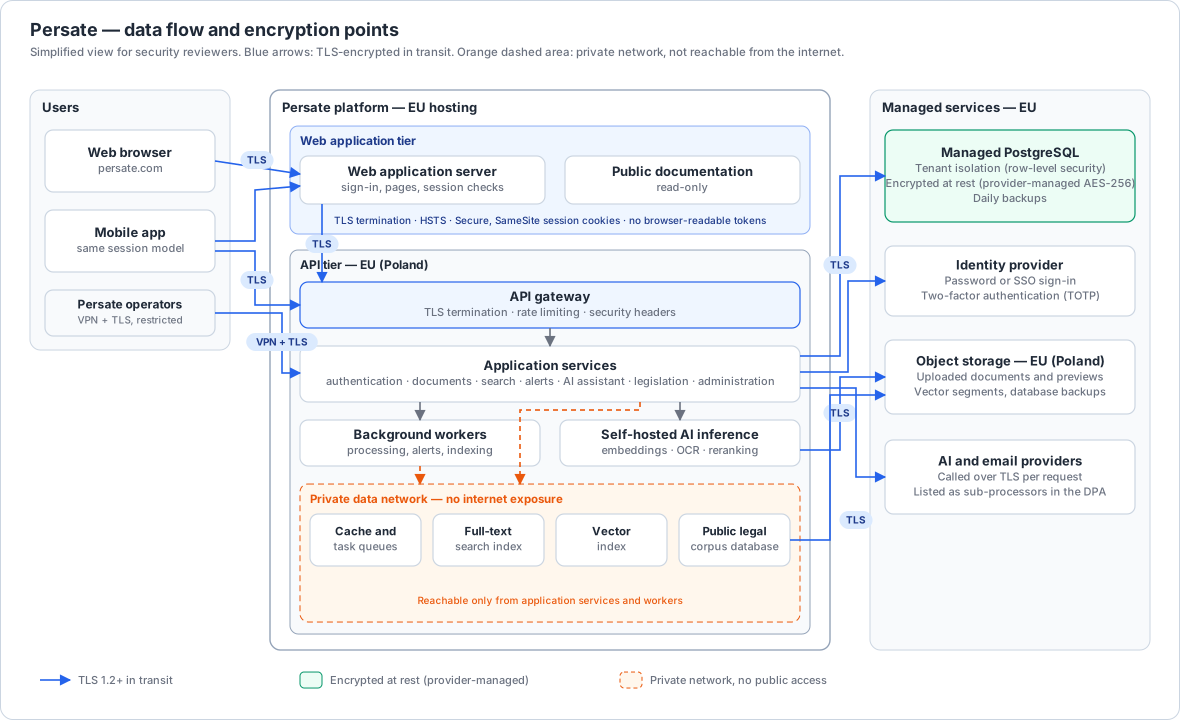
The diagram shows how data moves between users, the Persate platform, and the managed services it depends on, and where that data is encrypted.
Hosting and data location
- All platform components run in the European Union. Application services, background workers, and the self-hosted search, vector, and cache stores run in Poland. The managed PostgreSQL database and the identity provider run in the EU (Germany).
- Object storage for uploaded documents, previews, and backups is located in Poland.
- Self-hosted datastores (cache and task queues, full-text index, vector index, public legal corpus) sit on a private network with no public exposure. They are reachable only from application services and background workers.
- Administrative tools are reachable only through a VPN tunnel and are not exposed to the internet.
Encryption in transit
| Path | Protection |
|---|---|
| Browser or mobile app → web application and API | TLS 1.2 or newer; HSTS enforced on the application domain |
| Web application server → API | TLS; server-to-server hop authenticated with a dedicated internal key |
| Application services → managed PostgreSQL and identity provider | TLS |
| Application services and workers → object storage | TLS |
| Application services → AI and email providers | TLS, per request |
| Operator access to administrative tools | VPN tunnel plus TLS 1.2/1.3, restricted to the VPN address range |
| Deployments | SSH with key-based authentication and host key verification |
Encryption at rest
| Store | Protection |
|---|---|
| Managed PostgreSQL (tenant data, accounts) | Encrypted at rest by the provider (AES-256); daily backups |
| Object storage (uploaded documents, previews, backups) | Located in the EU; provider-side encryption at rest is being confirmed and will be stated here once verified |
| Self-hosted indexes and queues | Protected by network isolation and access controls; encryption at rest is not currently applied at the application layer |
Authentication and sessions
- Sign-in uses a password or single sign-on, followed by mandatory two-factor authentication (TOTP) before protected areas open.
- Sessions are carried in Secure, SameSite cookies scoped to the application domain and are validated server-side on every protected request.
- Roles and organisation membership are resolved from the server-side session. The administration area requires an administrator role.
- If the authentication service is unavailable, access fails closed rather than granting access.
- API traffic is rate-limited at the gateway and additionally per account for sign-in endpoints.
Tenant isolation
Each organisation's data is stored in its own database schema with row-level security policies, and search and vector indexes are partitioned per organisation. Requests carry the organisation context from the verified session, not from client input.